 |
 |
|
|
| The Sharp MD Story |
Sharp's first MD models, announced in January of 1993, were the MD-S10 and MD-D10 playback-only units, and at that time they were the world's smallest and lightest MD players. These products occupied one-third the volume and weighed one-half of the weight of the existing MD products available at the time. Since then, Sharp has continued to develop new MD models, such as the models listed below, that are consistently on the leading edge of MD technology and the industry.
*MD-Z1 Integrated MD/CD Component System, an industry first, introduced in January, 1994. *MD-X1 MD Component System that lets users enjoy MD, CD, cassette tape and AM/FM stereo entertainment. Introduced in September, 1995. *MD-MS100 Portable MD Recorder that enables users to insert or eject an MD at a single touch. Introduced at the end of 1995. *MD-S50 Portable MD Player that provides four hours of continuous playback time, the industry's longest at the time. Introduced in 1996. |
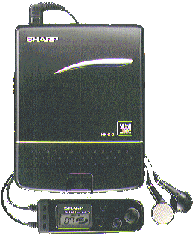 | 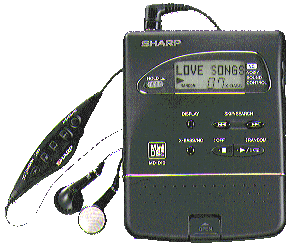 |
| MD-S10 | MD-D10(B) |
| Standardized MD specifications were first proposed in 1992. This new audio format succeeded in attracting much attention. The MD format has been billed as the next-generation of audio technology because of MD's outstanding combination of features including digital audio, a disc media that can be used more or less indefinitely, and nearly instantaneous song selection. At the same time, a competing technology was also being proposed--the digital compact cassette (DCC) which offered compatibility with existing analog cassette tapes. Beyond the fact that both approaches use data compression techniques, both would require new key components--for MDs, an optical read head (pick-up), special IC chips, and a disc mechanism, and for DCCs, thin-film heads and special IC chips. Also, these components required new micro-mounting technologies in order to assemble them with extreme high precision, and Sharp began to build prototypes of each format to see how many of these new key components could be made in-house, in order to develop new, originally featured Sharp products.
At this time, Sharp had successfully developed the key technologies needed for manufacturing both MDs and DCCs. Ultimately, after considering points such as that the worldwide consumer trend was moving away from tape and towards discs, and the fact that MDs were able to offer "quick access," "thin profiles," and "are a media that could be used more or less indefinitely," Sharp decided to focus its attention on developing MD products. |
| The development of Sharp's first MD model enlisted the cooperation of a great many related divisions within the company, but overall development responsibility fell to the Audio Equipment Division at Sharp Japan. Cross-division groups discussed the product image on numerous occasions, focusing on what kind of product users expected. The outstanding features of a MD system are its compact size and superb portability, and these were judged ideal for "outdoor use," away from the home or office. Accordingly, Sharp chose its objective from the standpoint of "ease-of-use" to build a playback-only unit that could fit in a shirt pocket. More specifically, the goal was to create a unit with a cubic volume equivalent to four discs plus one battery. After skillfully clearing a series of difficult development hurdles were Sharp's first two MD models were born in January of 1993--the MD-S10 and MD-D10 Players. |
| In a unit with a cubic volume equivalent to four discs plus one battery, we had to assemble the printed circuit board for processing digital signals, the optical read head to pick up signals from the disc, plus various mechanical components such as the motor to spin the disc, etc. The key to development success would be figuring out what it would take to to develop these new key components on such a small scale. This effort would have been impossible for just the Audio Equipment Division, the lead management group to handle by itself. We had to harness the power and effort of all relevant divisions in the entire company.
Accordingly, we created two new organizational systems--a "Special Project Team", which is a company-wide organization that cuts across divisional boundaries to commit needed personnel resources to product development. Also, a "concurrent development engineering group" consisting of top-level managers from the groups and research labs working on the project was created to provide support and back-up. These Special Project Teams are a unique Sharp organizational innovation which, in the past, have brought forth a number of hit products, including the LCD camcorder and the Sharp LCD ViewCam. Since the last half of the 1970s, these teams, which report directly to the President of Sharp, have become a means to forge strong horizontal links between vertically separated groups and divisions within the company. They are now firmly rooted as an organizational structure for bringing unique and innovative Sharp products to market quickly and efficiently. The concurrent development engineering group complements and supports the activities of the Special Project Teams. When problems come up during the project, top-level managers of divisions and labs whose staff are members of the project team meet to discuss issues that cannot be resolved by the teams alone. They also promote business opportunities beyond the immediate interests of the organization. The development of our first MD models involved 14 separate organizations within the company, in particular at that time, the Opto-Electronic Devices Division, the Integrated Circuits Group, and the Mechatronics Systems Laboratories. Their efforts yielded a super-compact spindle motor as well as a feed/return motor as thin as two stacked 1-yen coins, which were developed by the Mechatronics Systems Laboratories. Also, the Opto-Electronic Devices Division introduced hologram laser technology for the first time with the integration of the world's smallest "hologram laser pick-up" into the optical read head, which captures information from the disc. Another breakthrough was the creation of a set of IC chips based on 3-V drive voltage and integrated circuit logic, which previously had required six IC chips instead of just three. Thus, based on the development of these key components, in January of 1993, Sharp's MD-S10 MD Player was born, the world's most compact, lightest weight playback-only model. |
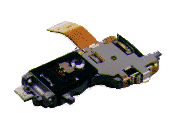 | 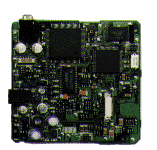 |
| Hologram optical read head | PC board |
| Concurrent engineering (CE) was used in the development of Sharp's MD-MS100 Portable MD Recorder, a record- and playback-capable model introduced at the end of 1995. CE yielded results in that it significantly shortened the time-to-market process. CE is a technique that facilitates the rapid development of products by conducting all processes simultaneously and in a parallel fashion, from planning and design to mass production.
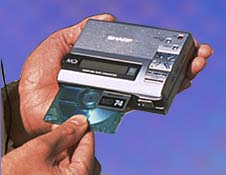
The outstanding features of the MD-MS100 include a "slot-in" mechanism that enables users to insert or eject a disc with a single touch--the first time this feature has appeared in a portable unit. "Slot-in" has been positioned as the symbol that generates the strongest impression among users highlighting the difference between MD players and tape cassette players. The Creative Life-Style Planning Group was given responsibility for product development, and together with a number of related divisions within the company, they hammered out a concept of a product with a thinner profile, lighter weight, longer continuous usage time, etc. At this point, the CE process, in which the planning, design, engineering, production and quality control divisions were all communicating with one another, became fully operational within Sharp. All relevant departments contributed jointly as a single integrated unit to solving problems related to developing the product, including design, specifications, key technologies, and mass production techniques. Further, in the MD-MS100, we integrated signal processing and data compression/decompression functions onto a single IC chip, making it possible to shrink the size of the unit even further. Here, an IC design technique known as as top-down design was adopted. This technique uses specialized software to allow operations previously performed by expert IC design engineers to be carried out by engineers in product divisions unfamiliar with IC design. By adopting techniques used in designing VLSIs in the design of simpler ICs for consumer use, we were able to reduce the IC design period by more than half of the 15 months previously required. In addition, our production technology group was able to offer valuable advice on optimal designs for mass production based on the results of experiments and tests accumulated over many years of experience. As a result, the development period for the MD-MS100 took only 10 months, less than half the time required with conventional techniques. In the future, Sharp will continue to confront the challenge of developing technological innovations for new key components, including more compact ICs, lowering power consumption, etc., and will work to develop even smaller, lightweight products and designs with increased battery-powered play times. |
  |



 The Sharp MD Story