| What are MDs? |
  |
 | Quick, random access lets you listen to your favorite song when ever you want |
| The fast-forward and rewind functions required to "cue up" a selection on a cassette tape require time and effort, and can be extremely troublesome. The rapid random access feature of MDs, however, let you select the song you want to hear instantly. For example, after the song you are currently listening to has ended, you can skip several songs and instantly access the next song you want to hear, or you can endlessly repeat only a favorite song and enjoy an ease of use impossible to duplicate with a cassette tape. Plus, new ways of enjoying MDs are coming on the scene all the time, such as marking the chorus section of recorded songs to create digest versions, or editing the originals, etc. |
| ATRAC audio compression technology makes it possible to record a tremendous amount of information on a compact media source |
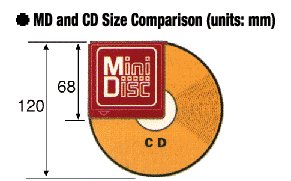
| An MD provides 74 minutes recording and playback time, the same as a standard audio CD, but in a diameter of only 64 mm, smaller than the palm of your hand. This ability to store such a large amount of information is the result of ATRAC, an audio compression technique developed specifically for use in MDs. This technology, based on the masking effect, cuts out faint sounds that would be completely obscured by louder sounds and also reduces the quantization noise generated when the amount of sampled information is decreased. By sampling only the portion of audio frequencies needed by the listener, ATRAC compresses the amount of information required to one-fifth of that of a CD. By solving the difficult problem of making a more compact media and ensuring high-quality digital sound, MDs were born. |
| Shock-resistant memory adeptly handles shock and vibration, the nemesis of discs | |
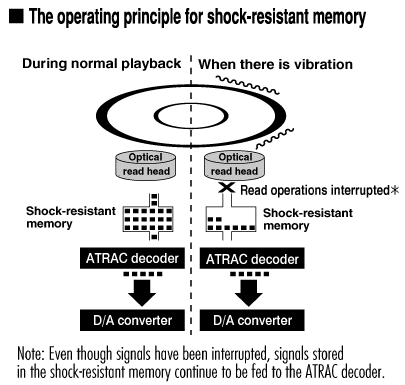
| The biggest weakness of discs is their susceptibility to vibration. MDs use solid-state semiconductor memory to counter the effects of vibration. A few seconds of signals read by the optical read head from the disk are first stored in digital form in solid-state memory before being reproduced as audio signals. Thus, when vibration or shock interrupts signals being read from the disc, digital signals can continue to be processed for the three-second* interval stored in memory. Provided the optical read head can get back to the original position on the disc within three seconds, the user will enjoy uninterrupted music. Thus, the means to prevent these annoying "skips" is not mechanical, but electronic. This approach practically guarantees uninterrupted music and makes MD players ideal for use in an active outdoor environment. | ||
| * | Models equipped with 1 Mbit of shock-resistant memory provide three seconds of uninterrupted music; this time will vary depending on the amount of memory. | |
| Dual-use media possible with optical discs--playback-only and record/playback |
| The major difference between CDs and MDs is that information can be directly recorded onto MDs. There are two types of MDs--a magneto-optical disc for recording, and a pre-mastered playback-only optical disc available in the marketplace as an audio media for music, etc. Recordable MDs use a magneto-optical system and record audio signals as magnetic information. In theory, these discs allow up to 1 million recording cycles, achieving a service life rivaling that of CDs. In addition, playback-only MDs use the same system as CDs, and because they read the differences in the amount of reflection when laser light strikes a "pit" on the surface of the disc versus a "land" and then converts these differences first to digital form before being processed into audio signals, there is no danger of accidentally erasing recorded sounds. |
| Durable and reliable with almost no sound deterioration MDs are virtually resistant to the effects of magnetic fields, dust and scratches |
| Because laser light is used to read signals during MD playback, no magnetic read head makes contact with the disc's surface. As a result, there is essentially no wear on the disc and no deterioration in sound. Moreover, because the disc is housed in a cartridge, it is practically fingerprint-proof, etc., and is durable enough for use in outdoor environments. Another major feature is its immunity to magnetic fields. Both playback-only and recordable MDs are unaffected by magnetic fields at normal room temperatures, and thus will remain in perfect condition, even if inadvertently placed near audio speakers or other sources of magnetism. And since they are a disc media, there is no stretching or tangling to worry about as with tapes. A new media born in pursuit of durability and reliability--this is the MiniDisc. |
| A Glossary of MiniDisc (MD) Technical Terms Just knowing these terms will let you understand advanced MD technology! |
 |
 | A/D conversion |
| Converts real-world analog signals into a digital format by separating the analog audio signal into fixed time intervals, converting the amplitude at each such point into a value, and calculating a binary number for this value, corresponding to a 1 or 0 pulse. See "D/A conversion." |
| ADIP (ADdress In Pre-groove) |
| Addresses are pre-formatted at fixed time intervals on a recordable MiniDisc which has been stamped with tracking grooves that have been formed in a wobble pattern modulated by a sine wave signal under constant linear velocity (CLV) control. |
| Analyzer |
| A spectrometer that splits light according to its polarization direction. |
| ATRAC (Adaptive TRansform Acoustic Coding) |
| The digital audio data compressing system developed for MiniDiscs. |
| CLV (Constant Linear Velocity) |
| A system which keeps the track length read by the pickup per unit time constant by gradually varying the rotational speed of a disc according to the location of the pickup on the disc (outer circumference versus inner circumference). |
| Curie temperature |
| The temperature at which magnetism of a specific material dissipates. This temperature varies according to the material. |
| D/A conversion |
| The conversion of digital signals represented by 0 or 1 to an analog signal. (See "A/D conversion.") |
| Decoder |
| A system to reconstruct signals processed for error correction, etc., and recorded onto the disc as an original digital audio signal. |
| DRAM (Dynamic Random Access Memory) |
| Solid-state read/write memory in which the cells require the repetitive application of control signals in order to retain stored data. Binary data (1 or 0) is represented as the presence or absence of a charge on a capacitive element formed within each memory cell. Used as a reservoir to store signals in MD players and recorders. |
| EFM (Eight to Fourteen Modulation) |
| The modulation system used to convert 8-bit encoded signals into 14-bit signals to match digital signals to disc transmission characteristics. |
| Kerr effect |
| A phenomenon in which the orientation of the polarizing plane of the reflected light of a laser rotates slightly forward or backward corresponding to the direction of the magnetized region. |
| Magnetic field modulation |
| The high-speed modulation of a magnetic field in magneto-optical recording to represent an input signal by magnetic orientation. |
| Magneto-optical film (MO film) |
| One of the key components of a disc. A thin film that can record and play back binary information based on magnetic reversal. |
| Masking effect |
| A psycho-acoustic phenomenon in which certain sounds are rendered inaudible by higher-level sounds on adjacent frequencies. |
| Overwrite |
| A system that re-records new data on top of data previously stored on the disc. |
| Photodetector (photodiode) |
| An electronic element that converts light to an electrical signal at a level proportional to the amount of incident light. |
| Pit |
| A hole formed directly underneath the reflective film layer of an optical disc; judged to be a 0 or 1 signal depending on its presence or absence. (Minimum length: approx. 0.9 ƒIm) |
| Polycarbonate |
| An engineering plastic that forms the substrate of magneto-optical discs. |
| Pre-groove |
| A guide groove created when recordable MiniDiscs are formed by injection molding. This groove assists in tracking control. The pre-groove is meandered in a certain pattern in order to create addresses for CLV servo control throughout the entire disc. |
| SCMS (Serial Copy Management System) |
| A copyright protection system developed to limit digital dubbing to first generation copies only. |
| Stamper |
| A metal-coated recording master on which are etched the pits, grooves, and addresses needed for mass producing (magneto-) optical discs. |
| TOC (Table Of Contents) |
| A generic term for all sub-data (disc name, track number, playing time, etc.) apart from the audio data. |
| UTOC (User Table of Contents) |
| Found only on recordable MiniDiscs, this area contains sub-data (track number, recording data, etc.) which can be rewritten by the user. |
| Wobble |
| The slight meandering of the tracking grooves formed on the disc (created by a sine wave signal under CLV control). |
| Basic MiniDisc Specifications (For all MDs) |
|
| Recording/playback time | 74 minutes | |
| Cartridge size | 72 x 68 x 5 mm | |
| Diameter | 64 mm | |
| Thickness | 1.2 mm | |
| Diameter (center hole) | 11 mm | |
| Diameter (beginning of program) | 32 mm | |
| Diameter (beginning of lead-in) | 29 mm | |
| Track pitch | 1.6µm | |
| Linear velocity | 1.2 to 1.4 meters/sec. (CLV) | |
| Channels | 2 channels (stereo/monaural) | |
| Frequency range | 5 to 20 kHz | |
| Dynamic range | 105 dB | |
| Wow and flutter | Within accuracy of quartz oscillator | |
| Sampling frequency | 44.1 kHz | |
| Compression system | ATRAC (Adaptive TRansform Acoustic Coding) | |
| Modulation system | EFM (Eight-to-Fourteen Modulation) | |
| Error correction system | CIRC (Cross Interleave Reed-Solomon Code) | |
| Laser wavelength | Standard 780 nm | |
| Laser diameter | Standard 0.45 | |
| Recording power | 5 mW (max.) | |
| Recording system | Magnetic Field Modulation | |
    |