The Increasing Level of Integration in IC Chips |
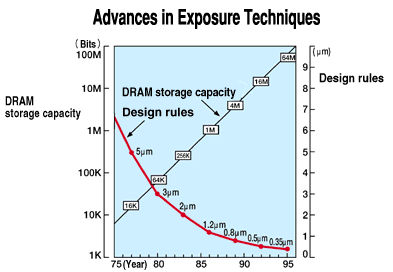
| The growing level of integration and rapidly increasing IC speeds have been achieved by shrinking the size of the circuit elements themselves. Cutting the "design rule" (a measure of process accuracy) by half allows the interconnections between elements to also shrink so that four times as many elements can be incorporated onto the same chip. This results in higher speeds and lower power dissipation.
Design rules in the 1970s, when Sharp first began developing ICs, were in the 10-micron range (1 micron = 1/1000th of a millimeter). Today, microlithography techniques and device fabrication technologies have advanced to the point where design rules are 0.35 microns, approximately 1/30th of what they were 20 years ago. This means that 10,000 times as many elements can be packed onto a chip with the same surface area. In the MD-S10, we were able to integrate functions which previously required six IC chips onto three, and in the MD-MS100, the functions of two chips onto a single IC. It is the results of these technological innovations that have allowed us to shrink product sizes. |
     |