|
|
| Product: MD-MX20 Minidisc Home Stereo |
Company: Sharp Electronics |
| Web: www.sharp-usa.com |
Phone: 800-237-4277 |
| Platform: Not your bookshelf |
SRP: US$300
Street Price: $280 |
Cred Rating: | Special Award: |
I've been in the market for a home minidisc player for a long time, and since I liked the portable Sharp MD821 so much, I thought the best place to look was Sharp. When they came out with their new line of low-priced home MD players, I figured it was time to try one out. The result? I'm left wondering what happened to the engineering geniuses who designed the MD821 -- did they retire after their success with the 821? Or did they just leave the MD-MX20 to less adept designers. Interns perhaps.
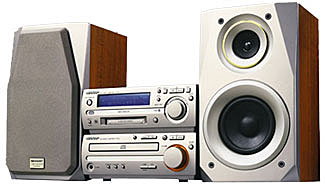
The first thing I noticed when I took the MD-MX20 out of the box was the size. Pictures on the Web (see above) make the unit seem compact. It's a "bookshelf system" and the pictures make it look like a short and narrow stacked MD and CD player. Well, it is short and narrow, but it's very deep. So deep, in fact, that it doesn't fit on my bookshelf -- at 12.5 inches deep, it's much longer than most standard bookshelves. It's odd that it should take so much space, considering that the portable minidisc players Sharp puts out are the tiniest on the planet. The pleasant surprise was that it is not a stacked two-piece system, but instead, just one piece. The advantage of this is that there aren't any cables to hook up except to the speakers, and the CD, MD and tuner all work together seamlessly. Once I got over the size of it, I started appreciating other things, but I was left with a "if only they had..." feeling about some of its features.
The MD-MX20 is the perfect college dorm-room system. The power is fine for smallish spaces, and the sound quality is adequate enough for ears already damaged by too much Korn. Better speaker wire may improve the sound, but I haven't had a chance to replace the extremely low-grade wire that came with it. Sound quality may also be better on the MD-MX30, which has 20 watts per channel compared to the 12 of the MD-MX20. To improve sound quality, the Sharp does have a graphic equalizer of sorts -- it can be set for half a dozen different pre-set patterns ranging from "concert" to "voice," and it also has surround-sound. The multi-color display shows track number/name info, as well as the usual flashing lights of unknown meaning.
The other thing that flags this stereo as marketed to college kids is the motorized volume control. Not only does the remote actually turn the knob, but the knob moves in and out, becoming completely recessed with the touch of a button. Doing anything with the volume also triggers the flashing orange light that encircles the knob. It's pure showmanship that would be appreciated in an exceptional home unit with lots of bells and whistles, but in this case, it just seems like wasted energy.
The Sharp does sport some great features, the best being the high-speed dubbing from CD to MD. I was able to throw in a disc and have an MD ready to go in only 15 minutes. That is something that is indispensable in a home unit. Since it's digital-to-digital, there is no loss of sound quality either. But the Sharp doesn't have external digital input, so you can't record from any other digital source. Analog RCA cables will let you throw down some MP3s onto MD though, so you can still get your Internet music fix.
The MD-MX20 can make great mixed MDs in double-quick time. CDs can be played back in programmed order to record a few songs at a time, and then MD tracks can be shuffled around and edited as needed. The Sharp has a full featured track/album titling function, which is controlled with a knob and a few buttons. Regrettably, Sharp failed to take advantage of the large display and all the buttons they could have put in -- editing on the MD-MX20 is no easier than on the MD821.
Another great feature for college students is the timer. The MD-MX20 can be set like an alarm clock, to start on either CD, MD or radio. That means you can wake up to your favorite tunes from any source. My current selection is the cacophony of alarms from Pink Floyd's "Dark Side of the Moon." If that doesn't roust you, even after a long night of...ah...studying, I don't know what will. Of course, since it can start with a minidisc, any sampled or recorded sound can be used (a recording of my mother's voice, or the roar of a Cat 3208 diesel engine are options I've explored).
The timer can also be used for recording. It takes only about a minute to set up the MD-MX20 to turn itself on at 7:00 AM and record the morning news from NPR, then turn itself off (others may prefer Howard Stern or other morning shock-jocks, but since I turned 30 last week, I am now officially an "old fart"). I now roust myself around 8:30ish with only a few minutes to shower and get out of the house, so I just grab the recording of the morning news to listen to on my commute via subway.
There is also a sleep function that lets you drift off to your favorite tunes, and automatically turn itself off after up to 2 hours. While this works very well, and doesn't interfere with the wake-up alarm, the unfortunate thing is that the source and volume of each function cannot be separately programmed; if you like to drift off to soft classical music but wake up to Kid Rock, you either have to make a very odd mixed MD or you just lose out. I managed to do my own version of this by making a mixed MD of the first 2 minutes of Pink Floyd, and the rest classical, but it is not an ideal solution. And doing that means that the timer record function will not work. I guess I can't expect everything, but independent source and volume functions would have made the MD-MX20 a lot more flexible.
I am left with more lingering questions: if my tiny little MD821 has optical input, why doesn't the MD-MX20? Why is it so big? Why not have a more full-featured timer? And is it because these engineers were concentrating making the volume knob senselessly go in and out that they didn't think of all the other things that could have made the MD-MX20 so much better?
Even with its few clueless aspects and missed opportunities, I do like the MD-MX20. Would I put my own money down for it (this was an Street Tech evaluation unit)? Probably. It is a very solid low-priced home stereo with basic MD/CD functions and a few nice add-ons. For the same price as the MD821 prtable, you get a fully integrated CD/MD and some decent speakers. Not a bad deal.
- Nate Heasley [9/18/00]
Check out:
Today's Tech Term
Today's Software on Cool Tool of the Day
Street Tech's Digital Living Today
|